
Vision to Impact: 20 Years of the Micronesia Challenge
By Mae Bruton-Adams, Chief Executive Officer, Micronesia Conservation Trust
March 28, 2026. Twenty years to the day since five island governments stood before the global community and declared they would protect their own waters and lands - on their own terms, at their own ambition - and the anniversary came and went like any other Saturday. No ceremony. No commemorative resolution. Just the work, continuing.
In March 2006, at the eighth Conference of the Parties to the Convention on Biological Diversity, five island nations made a commitment unlike anything that had been done before.
The leaders of the Federated States of Micronesia, the Republic of Palau, the Republic of the Marshall Islands, Guam, and the Commonwealth of the Northern Mariana Islands pledged to conserve at least 30% of their near-shore marine resources and 20% of their terrestrial resources by 2020. Five island governments, spanning an ocean area roughly the size of the continental United States, chose to act together, ambitiously and on their own terms. President Tommy Remengesau Jr. of Palau stood before the international community and issued a challenge. Not a request. Not a proposal. A bold global declaration made by some of the smallest countries in the world.
What twenty years built
The numbers are real and worth naming. Since the Challenge was launched, over $100 million has been leveraged for conservation across the region, more than 150 protected areas have been established, and new fisheries management policies were enacted. Thousands of community members are also engaged as stewards of their own lands and waters.
But the more durable achievement is institutional. The Micronesia Challenge created the conditions for locally led conservation to take root as a permanent feature of how these islands govern their natural resources. It inspired the Coral Triangle Initiative, the Caribbean Challenge, the Hawai’i Aloha+ Challenge, and the EU’s Biodiversity and Ecosystem Services in Territories (BEST) initiative operating across Pacific overseas territories. And in 2019, the five island nations raised their ambition to effectively conserve 30% of their marine and terrestrial resources and effectively manage 50% of marine resources by 2030. That expansion was not a diplomatic gesture offered to a global audience. It was a commitment made first to their own people, a declaration that the cultures, traditions, and ways of life that have sustained Micronesian communities across generations would not be surrendered to inaction.
The Micronesia Conservation Trust became the dedicated financial mechanism for the Micronesia Challenge, a deliberate decision to build on existing, locally governed conservation finance rather than create something new, and to sustain conservation work in the region beyond the next grant cycle. That remains as important today as it was in 2006.
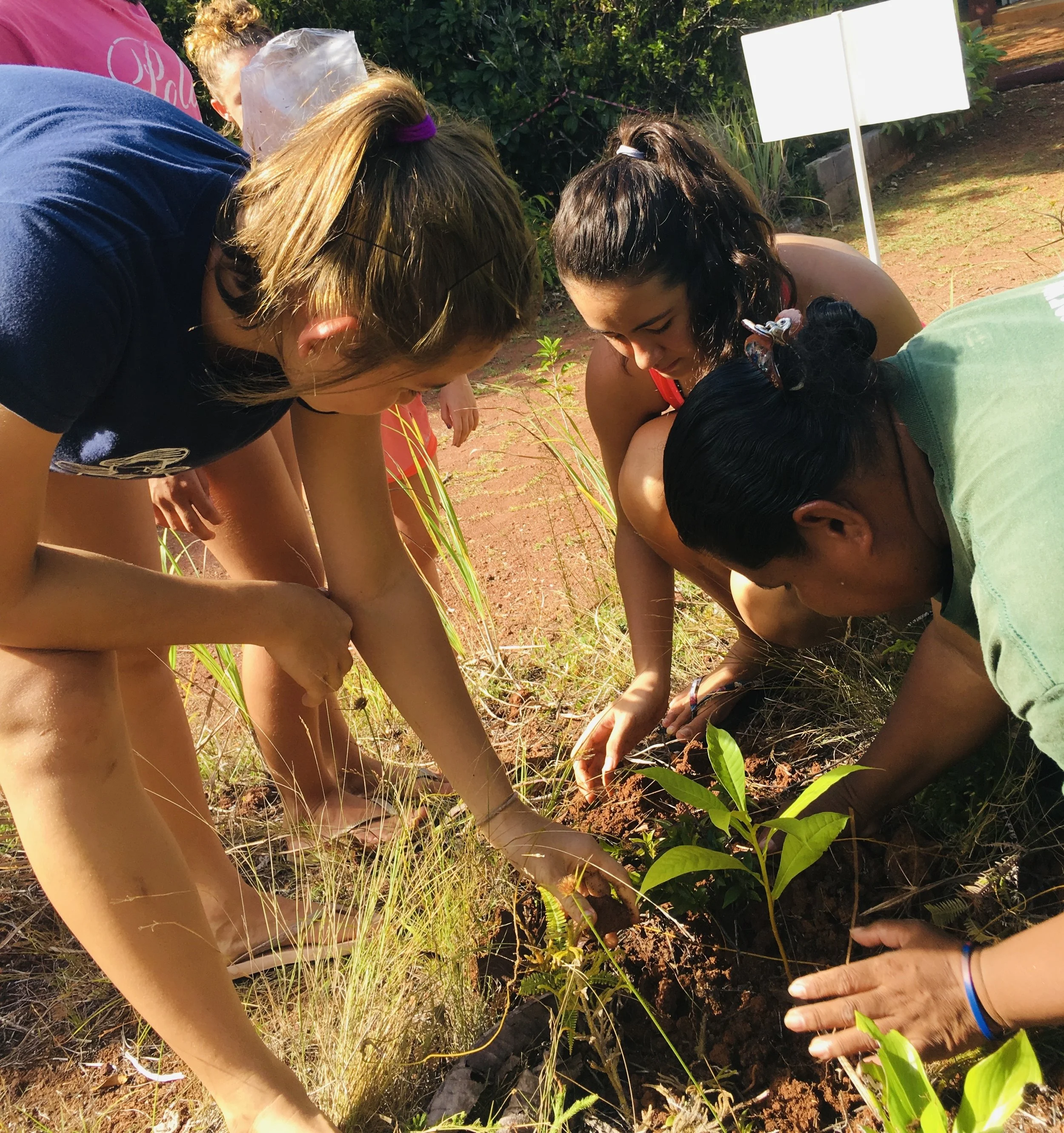
Youth planting trees in Micronesia.
What the world stands to gain
The Pacific Ocean covers roughly a third of the planet's surface. Pacific Island nations are custodians of more than half the world's tuna catch, a protein traded globally and consumed on every continent. The ocean produces 50-80% of Earth's oxygen through marine phytoplankton and absorbs about 30% of human-generated carbon dioxide. Small Island Developing States collectively steward 20% of global biodiversity and 40% of the world's coral reefs. These are not regional resources; they are vital planetary infrastructure.
Yet the people managing this infrastructure contribute less than 0.03% of global greenhouse gas emissions. Between 2014 and 2019, approximately $3.3 billion was committed to Pacific Island nations for all climate-related projects combined. Against an estimated need of $1 billion per year for adaptation alone, that is less than one year's worth of need delivered across six years, and only about half of what was committed was actually disbursed. The global biodiversity finance gap stands at an estimated $700 billion per year, a figure now embedded in the Kunming-Montreal Global Biodiversity Framework, and fifteen Pacific nations only formally launched a regional Biodiversity Finance Programme in mid-2025. The architecture for resourcing this work at the scale it deserves is still being built, and that is an invitation. The returns on adequately financing Pacific-led conservation are measurable, they are global, and the Micronesia Challenge has spent twenty years proving it.
On innovative finance and who carries the cost
When the global conservation and climate finance community speaks of innovative financing mechanisms, the conversation gravitates quickly toward bonds (green bonds, blue bonds, debt-for-nature swaps). The language is sophisticated. The underlying structure is not: it is debt.
Pacific Island nations are being asked to borrow money to protect ecosystems that regulate the global climate, produce oxygen, and absorb carbon, services for which no invoice has ever been issued and no market price has ever been set. They are custodians of a global commons, and the current architecture asks them to finance that stewardship themselves.
The deeper problem with loan-based mechanisms is not simply where the lending institution is headquartered. It is when finance flows through large multilateral intermediaries that the priorities, conditionalities, and project design requirements reflect the funder's framework rather than the community's knowledge. Direct financing, by contrast, puts decision-making authority with the people who have spent generations understanding these ecosystems. The Micronesia Challenge and MCT are working models of exactly that approach, and the track record speaks for itself.
The work continues
Pacific Island nations are not waiting to be saved. However, the value of what we steward is not yet fully understood by the world that benefits from it, and that is something we can change.
We, the custodians of these oceans and ecosystems, will continue to tell this story, with clarity, with evidence, and on our own terms. The Micronesia Challenge has proven for twenty years that locally led conservation works. The commitment now is to ensure that proof is heard in every room where decisions about our oceans, our resources, and our future are made.
In 2006, five island governments stood in Curitiba and declared: we will not wait. Twenty years and twenty-three administrations later, that declaration still holds.
Happy anniversary, Micronesia Challenge!
