
Reclaiming Resilience: How Micronesian Women are Leading on Climate Action
The Kiwa Initiative’s Women’s Work project is building a model for women-led action on biodiversity conservation, food security, and coastal resilience. This regional project places women at the center of decision-making and honors traditional practices in communities across the Federated States of Micronesia, the Marshall Islands, and Palau.
The Kiwa Women’s Work project — managed by the Micronesia Conservation Trust (MCT) with technical support from The Nature Conservancy (TNC) — fosters women’s learning, links ecosystem health with sustainable livelihoods, and strengthens communities through nature-based solutions.
The project is also creating a replicable roadmap for women’s leadership in restoring habitats, supporting local economies, and preserving cultural values. Here’s how.
Breaking barriers
Across the Micronesia region, women hold generations of traditional ecological knowledge, yet have not always been represented in conservation decision-making.
Women’s Work, which kicked off last year, aims to change that by documenting and returning to their traditional knowledge of local resource management — from where to plant salt-tolerant taro varieties to how to nurse mangroves back to health to which reef areas should be prioritized for protection and restoration. The project blends ancestral techniques with capacity building, training 20 groups (approximately 500 women across three countries) in climate adaptation, nature-based solutions for food systems, and sustainable livelihoods. It will also offer technical workshops on mangrove planting, sustainable taro cultivation, and habitat restoration.
The project will also elevate the voices of 20 female leaders in local, national, and regional climate and food-security forums. This work includes strengthening the capacity of these leaders, and providing platforms to shape the conversations that matter most to their communities. Additionally, a regional Women's Climate Network is being developed to deepen this impact through knowledge sharing and peer learning across island communities.
These mechanisms are intended to make leadership sustainable rather than project-dependent: women trained today become mentors and decision-makers tomorrow.
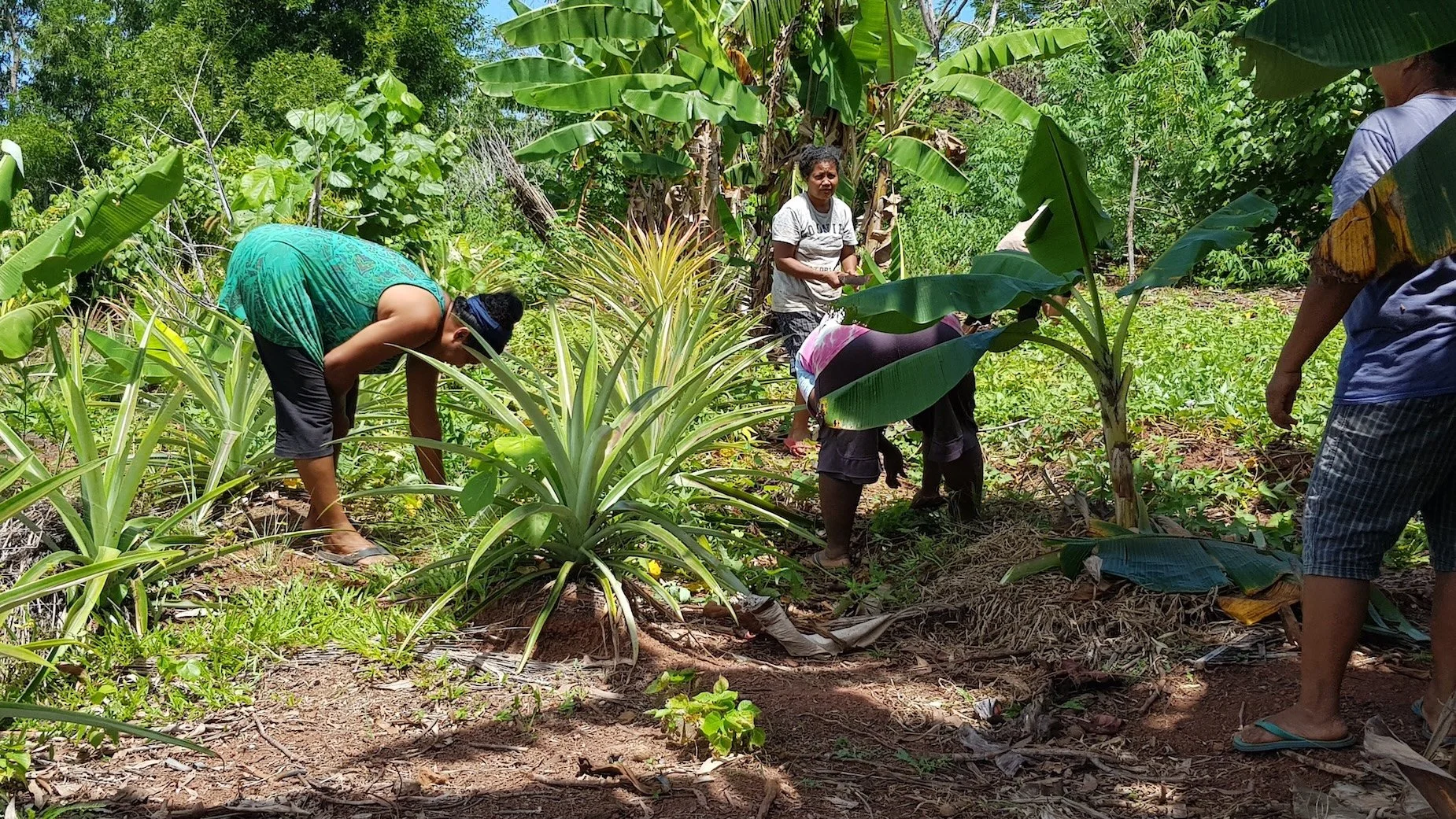
Women working in community gardens in Yap, Federated States of Micronesia. Photo credit: Berna Gorong, TNC.
Ensuring sustainable livelihoods
Sustainable ecosystems underpin sustainable livelihoods, including agriculture and management of vital natural resources such as coral reefs and mangroves.
Women’s Work expands access to income-generating opportunities linked to sustainable resource management that encompass nature-based solutions. For example, reef recovery initiatives that enhance marine health and support local fisheries that households rely on for protein and income.
A diverse group of implementing partners—from state governments in Palau to organizations such as the Conservation Society of Pohnpei in FSM and the Marshall Islands Conservation Society—are partnering with women’s groups across the region to design and implement activities grounded in local priorities and knowledge. MCT provides technical guidance and training, helping to strengthen the capacity of these partners to access, manage, and sustain conservation funding over time.
Driving climate progress and resilience
The Women’s Work project aims to reduce climate vulnerabilities for 20 rural communities across 12 islands by restoring degraded habitats — taro patches, mangroves, reefs and forests – across 40,000 hectares (equivalent to more than 150 square miles, and 100,000 acres).
Successful conservation efforts in the Micronesian region – and across the globe – depend on locally led execution. Women’s Work restoration efforts are community-led and informed by participatory consultations held in September-October last year. The project is now developing 20 community-specific action plans, working with women’s groups in communities across the region, including locations such as Ngardmau in Palau, Aur Atoll in the Marshall Islands, and Yap in the Federated States of Micronesia. These will be accompanied by tailored monitoring tools and indicators to track progress and outcomes across terrestrial and marine ecosystems.
Key project activities aim to build directly on women’s traditional knowledge and leadership, combining ancestral practices with new tools and support. Activities will include:
Reviving traditional taro cultivation and coastal gardening to increase local food availability and buffer households against climate shock disruptions.
Replanting mangroves and managing seagrass and reef areas to reduce coastal erosion and protect infrastructure, improve fish habitat, and strengthen natural defenses against storms.
Reforesting upland areas to protect watershed function and stabilize soils.
Establishing nurseries, developing propagation techniques, and training community monitors to sustain restoration work.
The project emphasizes collaboration to scale and accelerate progress. Partnerships and community relationships build trust, strengthen capacity, and help effective leaders emerge.
Changing the narrative
Women across the Micronesia region are essential to climate resilience and food security. As stewards of coastal ecosystems, they apply nature-based solutions and preserve traditional practices that reflect community needs and improve livelihoods.
Indeed, Micronesian women have always held central roles in governance and stewardship — determining leadership, holding land, and anchoring community life. This project seeks to reassert that authority within formal decision-making spaces, recognizing that western governance structures have sidelined, but never extinguished, local community systems of leadership and resource management;
As the Kiwa Initiative and partners scale Women's Work, Micronesia offers a a compelling model: amplify local community knowledge, elevate the women who hold it, and place both at the forefront of climate resilience — where they have always belonged.
About the Kiwa Initiative – The Kiwa Initiative - Nature-based Solutions (NbS) for Climate Resilience aims at strengthening the climate change resilience of Pacific Islands ecosystems, communities and economies through Nature-based Solutions (NbS), by protecting, sustainably managing and restoring biodiversity. It is based on an easier access to funding for climate change adaptation and NbS for local, national authorities, civil society and regional organisations of Pacific Island Countries and Territories including the three French overseas territories. The Initiative is funded by the European Union, Agence Française de Développement (AFD), Global Affairs Canada (GAC), Australian Government Department of Foreign Affairs and Trade (DFAT) and New Zealand Ministry of Foreign Affairs and Trade (MFAT). The Kiwa Initiative has established partnerships with the Pacific Community (SPC), the Secretariat of the Pacific Regional Environment Programme (SPREP) and the Oceania Regional Office of the International Union for Conservation of Nature (IUCN-ORO). For more information: The Kiwa Initiative - Climate Resilience in the Pacific Islands thanks to Nature-based Solutions (NbS)
